
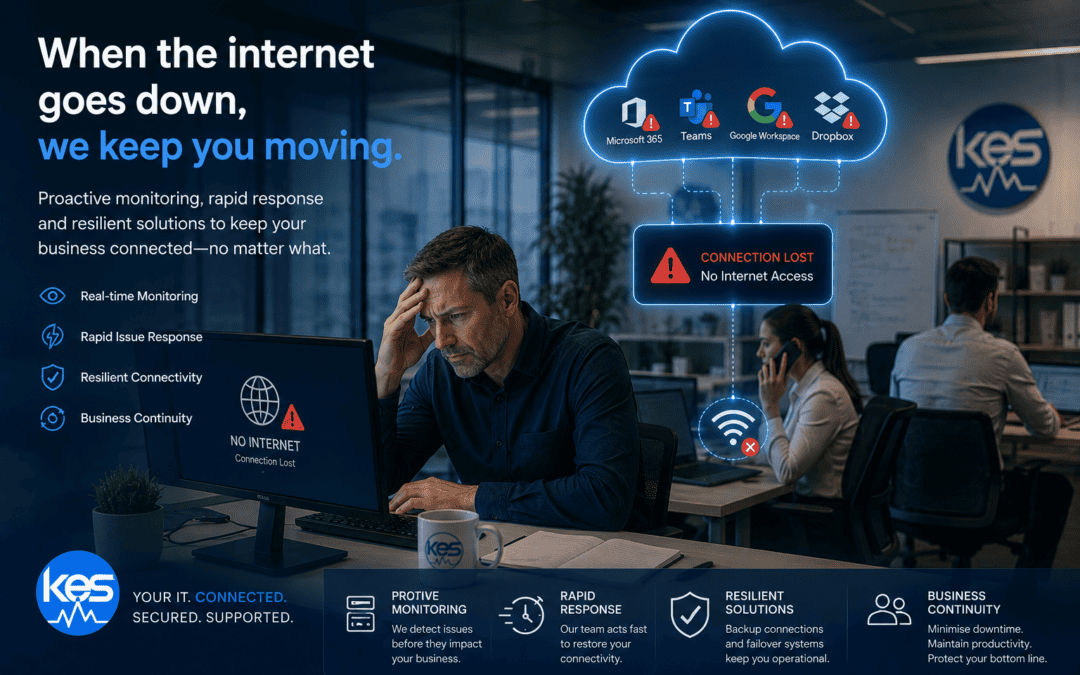
For many SMEs, internet connectivity is now central to almost every operational process.
When connectivity fails, the impact is no longer limited to web browsing. Staff may lose access to Microsoft 365, VoIP systems, cloud files, Teams calls, remote systems and client communications simultaneously.
That is why internet outages increasingly become operational incidents rather than simple technical inconveniences.
Modern businesses rely heavily on cloud systems
Many SMEs now operate using:
- Microsoft 365
- Teams
- SharePoint
- cloud backup
- hosted VoIP
- remote access
- cloud-based line-of-business systems
When internet access fails, those systems may become unavailable immediately.
In some businesses, that can stop operational activity almost entirely.
Microsoft 365 dependency changes the risk picture
A growing number of SMEs now depend heavily on Microsoft 365 for:
- communication
- document access
- collaboration
- file storage
- remote working
Without internet access:
- Outlook may stop synchronising
- Teams calls fail
- OneDrive access becomes unreliable
- SharePoint files become inaccessible
You can also review:
Microsoft 365 guidance for SMEs
This means connectivity resilience is increasingly tied directly to business continuity.
VoIP systems also depend on stable connectivity
Many businesses have replaced traditional phone systems with hosted VoIP platforms.
While flexible and cost-effective, VoIP systems rely on stable internet connectivity.
If the connection fails:
- inbound calls may stop
- outbound calls may fail
- call quality may degrade
- customer communication may be disrupted
For customer-facing businesses, that can quickly become commercially damaging.
Backup connectivity can reduce operational disruption
One of the most effective ways to reduce connectivity-related disruption is implementing backup internet connectivity.
This may include:
- secondary broadband lines
- mobile failover
- dual-WAN firewalls
- automatic failover systems
The goal is not necessarily zero downtime.
It is maintaining enough operational continuity for staff to continue working during primary outages.
You can also review:
Backup & Recovery guidance for SMEs
Connectivity resilience should match operational dependence
Not every business requires the same level of resilience.
A small office with limited cloud dependency may tolerate occasional disruption.
A professional services firm relying on:
- Microsoft 365
- VoIP
- cloud collaboration
- remote working
- hosted systems
may require stronger redundancy and support agreements.
The key question is:
“What happens operationally if the internet fails for several hours?”
That usually provides a more useful basis for decision-making than speed comparisons alone.
Connectivity should be reviewed proactively
Many SMEs only review connectivity after a serious outage.
By that stage, the operational impact has already occurred.
A proactive review should consider:
- broadband reliability
- Wi-Fi performance
- firewall configuration
- failover capability
- cloud dependency
- remote working requirements
- VoIP usage
You can also review:
Connectivity guidance for SMEs
Reliable connectivity is now part of operational resilience.
As businesses become more cloud-dependent, internet reliability increasingly affects productivity, communication, client service and business continuity directly.
